Are CPU Coolers Universal? – Upgrade Smart 2025!

No, CPU Coolers are not universal. While many models support multiple sockets, true compatibility depends on three factors the socket pitch, the cooler’s TDP rating, and case clearance. Always check specifications to confirm if a CPU cooler is universal for your build.
In this guide, we will explain why are CPU coolers universal is not always universal. You will learn the three important checks: socket, TDP, and clearance that can make or break your build.
The Universal Cooler Myth:
The idea of one cooler fitting every processor is attractive, but modern CPUs are too diverse in size and power consumption
Why Compatibility Depends on Three Factors?
Compatibility is a three-factor problem. A successful fit requires checking three distinct areas:
- Socket Compatibility: Does the mounting plate align with the precise holes on your motherboard? This is a non negotiable physical match.
- Thermal Compatibility TDP: Can the cooler efficiently dissipate the maximum heat load your CPU generates during turbo boost?
- Physical Clearance: Can the cooler fit within your case while avoiding RAM modules and VRM heatsinks?
CPU Socket Compatibility Explained:
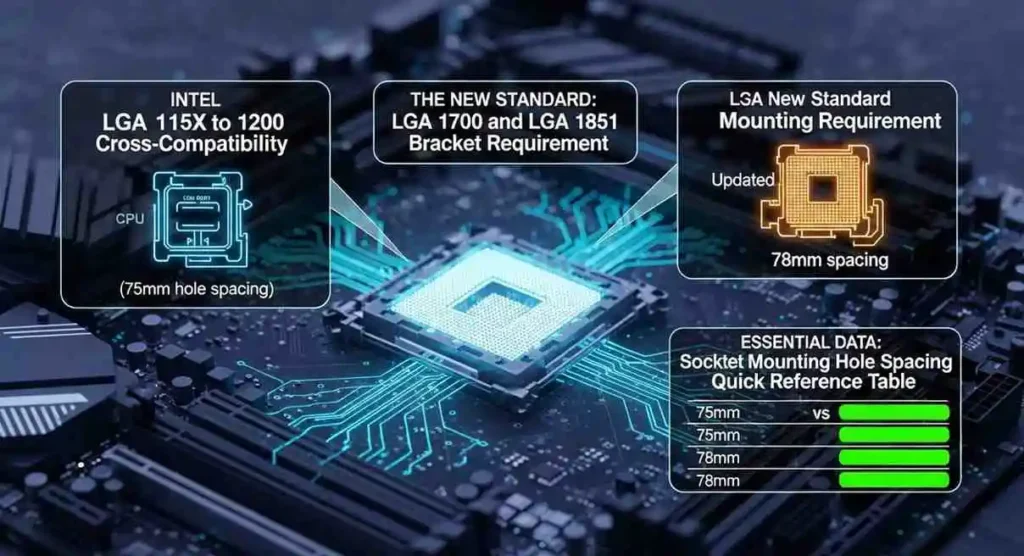
The fundamental compatibility check relies solely on the spacing of the mounting holes around the CPU socket. If the cooler’s mounting bracket does not align with these holes, the cooler cannot be installed.
Intel LGA 115X to 1200 Cross Compatibility:
Intel’s previous mainstream sockets, from LGA 1150 through LGA 1200, share an identical 75mm x 75mm mounting pitch. This means most older coolers are compatible with LGA 1200 motherboards, often requiring only a basic bracket.
Required Socket Brackets:
The 12th generation onwards requires a new bracket due to a larger 78mm x 78mm spacing. Coolers designed for LGA 1200 will not fit LGA 1700 or LGA 1851 boards without this specific upgrade kit.
Socket Mounting Specs:
This table summarizes the core physical dimensions required for cooler mounting. Always verify your socket against these measurements before purchase.
| Socket Type | Platform Example | Mounting Hole Spacing | Compatibility Note |
| Intel LGA 115x / 1200 | 6th to 11th Gen | 75mm x 75mm | High cross-compatibility within this group. |
| Intel LGA 1700 / 1851 | 12th to 15th Gen | 78mm x 78mm | Requires a specific 1700/1851 bracket. |
| AMD AM4 / AM5 | Ryzen 1000 to 9000 | Backplate Based | Most AM4 coolers are compatible with AM5. |
Also Read: Can you Plug CPU Fan into System Fan? – Full Guide!
Do Intel and AMD Coolers Fit Each Other?
No, standard Intel coolers and AMD coolers cannot be used with each other’s sockets without the correct universal mounting kits provided by the cooler manufacturer. The base mounting mechanisms are fundamentally different.
LGA 1851 Deep Dive Pressure Warnings:
Intel’s previous mainstream sockets, from LGA 1150 through LGA 1200, share an identical 75mm x 75mm mounting pitch. The new LGA 1851 socket introduces changes in mounting pressure requirements. For official specifications, see Intel LGA 1851 socket guide.
Adding aftermarket washers to Z890 motherboards risks critical thermal failure. The washers prevent the cold plate from making proper contact with the CPU. Rely on the cooler’s factory pressure and avoid using washers entirely.
AMD AM4 to AM5 Stack Height Advantage:
AMD maintained the stack-up height and backplate thread pattern from AM4 to AM5. This consistency ensures nearly all AM4 coolers are instantly compatible with the newer AM5 socket, requiring no new brackets for standard tower coolers. See the AMD cooler compatibility guide for official recommendations.
Future Proofing AM6 Cooler Compatibility:
AMD is expected to maintain cooler compatibility for the future Socket AM6 (Zen 7) platform, anticipated around 2028. Though the pin count will increase to 2100, the physical size is projected to remain similar to AM5.
CPU Cooler Compatibility Factors:
Beyond the socket, two other factors dictate cooler selection: the power it needs to handle and the space it occupies. Getting these three dimensions right is key to confirming Are CPU Coolers Universal for your build.
Calculating Real World Heat Load:
TDP measures the maximum heat a processor is designed to generate. Modern high performance CPU, however, consume significantly more power during Turbo Boost than their base TDP rating suggests.
You must size your cooler based on the CPU’s maximum boost wattage, not the base TDP. If your 65W TDP processor boosts to 150W peak, your cooler needs to handle at least 150W effectively.
Air Cooler RAM & VRM Clearance
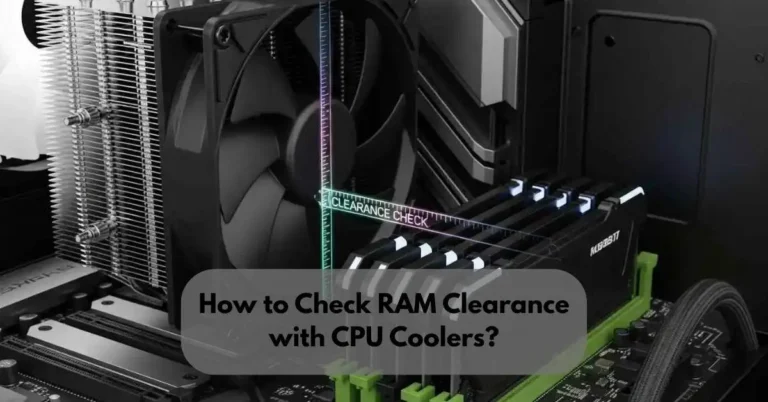
Large air coolers can easily overhang tall RAM modules or collide with motherboard VRM heatsinks. Always check the height of your RAM against the cooler’s specified clearance before purchase.
Liquid Cooler Fitment Guide:
AIO compatibility relies on case support for radiator size, such as 240mm or 360mm. Also, ensure the tubing is long enough to reach the CPU block, especially in larger full-tower cases.
Also Read: Is 4000 RPM Too Low for CPU Fan? – Safe Range Guide!
Cooler Size, TDP & Case Clearance:
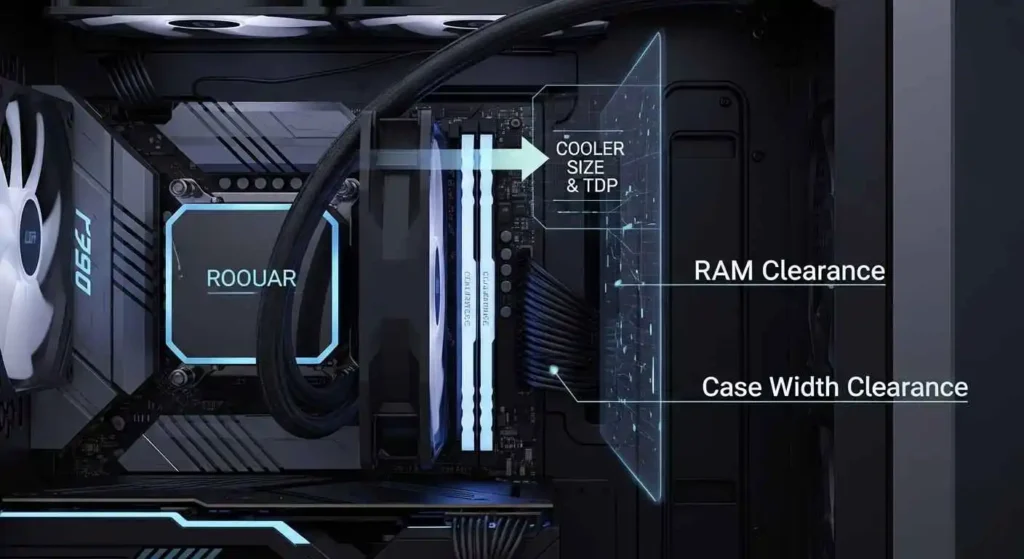
Choosing the correct size is a balancing act between thermal performance, noise, and physical dimensions.
How Much Wattage Headroom Do You Need?
Do not settle for a cooler rated exactly at your CPU’s TDP. For stability, the cooler’s capacity should exceed the CPU’s peak wattage by 50 to 75 Watts. This thermal headroom ensures efficient operation even under sudden, heavy loads.
Case Form Factor & Radiator Size:
Optimal radiator size depends on your case:
- Mini-ITX/Micro-ATX: Typically 120mm or 240mm (with a tight fit).
- Mid-Tower: Best for 240mm, 280mm, or 360mm radiators.
- Full-Tower: Supports up to 360mm or 420mm for maximum cooling potential.
Checking RAM Height & Fan Fitment:
Check the specific height of your RAM modules online. Some large tower coolers allow the front fan to be shifted upward to clear tall RAM, but this increases the cooler’s total height.
Universal Mounting Kits & Brackets:
The universal part of a cooler is its ecosystem of brackets. Most premium coolers support every major socket through interchangeable mounting hardware. This confirms that Are CPU Coolers Universal applies only to the bracket system.
When is a Free Upgrade Kit Available?
When a new socket is launched, such as LGA 1851, manufacturers often offer free upgrade kits to customers. You typically need to provide proof of purchase for both the cooler and the new CPU or motherboard.
Why AM4 Coolers Fail on AM5?
Low-profile coolers that require the replacement of the AMD stock backplate are generally incompatible with AM5, as the backplate is a permanent component. Specialized mounting kits are needed for these specific models.
How to Check if a Cooler Fits Your CPU?
Follow this checklist to ensure complete compatibility before you open the box:
1: Matching Mounting Hole Dimensions:
Verify the cooler explicitly lists your exact CPU socket support and check the mounting pitch (75mm or 78mm).
2: Verifying Thermal Headroom:
Confirm the cooler wattage capacity exceeds your CPU’s maximum expected boost wattage by a significant margin for reliable cooling.
3: Measuring Case and RAM Clearance:
Check your case maximum cooler height and your RAM module height against the cooler specifications to prevent physical clashes.
Also Read: How to Check RAM Clearance with CPU Coolers? – Easy Guide!
A Guide to Universal CPU Cooler Buying:
When shopping, always prioritize coolers that ship with multiple mounting kits, covering the latest sockets, such as LGA 1700/1851 and AM5. Look for coolers with high thermal capacity ratings and detailed dimension charts, confirming they are designed to handle demanding workloads.
Why Compatibility Changes with Every New Generation?
Compatibility is never static because every new generation of CPU introduces either a physical change or an increase in power. Intel typically changes the socket size, while AMD maintains the socket size but increases thermal requirements. This evolution means builders must always re-verify components, even if Are CPU Coolers Universal is advertised.
Real World Installation Mistakes:
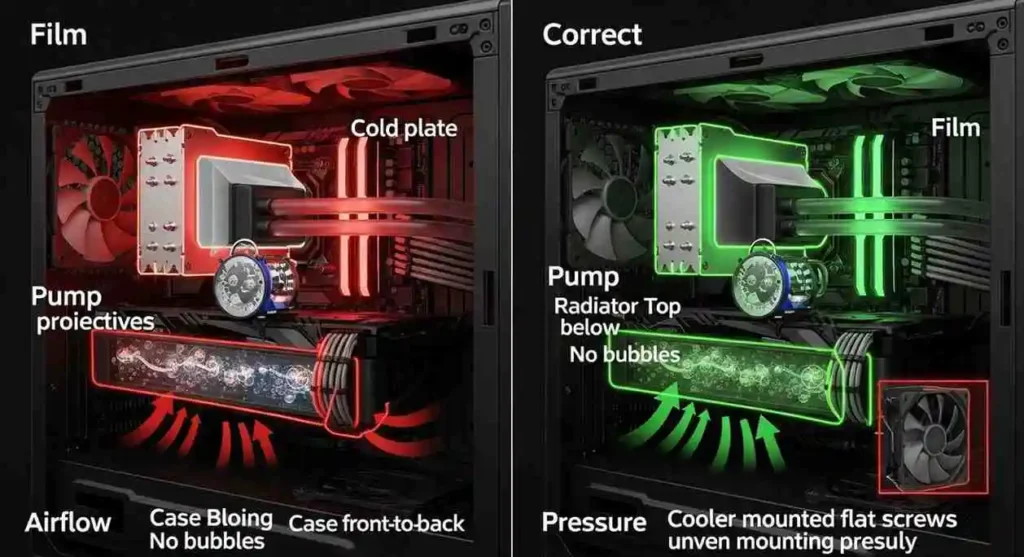
The biggest compatibility failures often happen not in theory, but during the installation process due to common errors or overlooked technical details. Mastering this section determines if CPU coolers universal for your hardware.
AIO Pump Cavitation & Failure:
A major cause of AIO failure is pump cavitation, which occurs when the pump runs dry due to trapped air bubbles accumulating inside the pump head. If the radiator is bottom mounted and the pump head is the highest point, air collects at the pump, which can cause noise and premature failure. The ideal solution is to top-mount the radiator.
Installation Mistakes Film & Pressure:
Even experts make these critical errors:
- Protective Film: Failure to remove the thin plastic film from the cold plate can result in immediate thermal failure.
- Pressure Errors: Too loose means poor contact; too tight risks warping the motherboard or socket. Aim for firm, even pressure.
- Airflow: Ensure the air cooler fan direction aligns with your case’s overall airflow path.
Case Study LGA 1700 Cooler on LGA 1851:
A user transferred their LGA 1700 cooler to a new Z890 board but left the small washers installed. On the LGA 1851 socket, these washers prevented the cold plate from touching the CPU heat spreader. This resulted in thermal failure, demonstrating that even minor component changes can compromise compatibility.
FAQs:
1: Can I Use an Old LGA 1200 Cooler on a New LGA 1700 Motherboard?
No. LGA 1700 uses a larger 78mm x 78mm spacing, requiring an LGA 1700/1851-specific mounting bracket kit.
2: Are AM4 Coolers Fully Compatible With the New AM5 Socket?
Yes, almost all AM4 coolers are compatible due to the same stack-up height and backplate thread pattern.
3: Does a Cooler TDP Rating Mean It Only Uses That Much Power?
No. TDP measures the heat produced, defining the cooling required; CPUs often boost well above their base TDP rating.
4: How Do I Know if My Large Air Cooler Will Interfere With My RAM Sticks?
Check the RAM module height against the cooler specified clearance. Adjusting the fan may increase the total height.
5: Are CPU Coolers Universal Across All Sockets?
No, CPU coolers are not universal. Compatibility depends on the socket type, mounting hole spacing, and case clearance. Always check the cooler supported socket list before buying.
Conclusion:
The term CPU Coolers Universal highlights compatibility but not a guaranteed fit. True success depends on the builder’s precision in verifying socket pitch, matching thermal capacity with CPU boost, and ensuring clearance. Skipping these essentials often turns the promise of a universal CPU cooler into frustration and performance disappointment.